
Afterword

My Aunt Dorothea Buchanan was one of the last survivors of the 1917 Halifax, Nova Scotia Explosion. She was six at the time of the catastrophe. Her youngest sister, my mother, would get irritated because Dot would recount that day with two different stories. Only one could have happened to her.

I think of this when I listen to interviewers talk with writers. One of their favorite questions is:  How much of your work is autobiographical?  A reciprocal question immediately arises from me: Does knowing whether something in the writing is part of a writer’s lived experience change the meaning of the story or the quality of the telling? I wonder at a reader’s need to know the exact veracity of a story, or to have a writer reveal more than they have offered. I wonder whether artists of other genres— musicians, painters, sculptors, dancers—are asked this question so pointedly. For a writer, it’s as if they have a responsibility to disclose themselves as upright citizens or frauds.

Creating fiction is a process of entering into the unknown with a lifeline to the known. No matter what we write, we are always tapping into the primordial foundation of what we believe we know about being our human selves. Asking the question of what is autobiographical in a novel is like asking whether a writer breathes oxygen. I find the question rather beside the point. The truths are in the story’s telling: the writer has offered up what they have chosen to bring to light.

This week I bought Wallace Stegner’s novel Crossing to Safety. Stegner is a writer I turn to because I trust his characters’ humanity. An Afterword by T. H. Watkins included this passage:

“He was a man of rectitude, with regard to himself as well others…in responding to inquiries about his personal history he would, as often as not, refer the questioner to his fiction as the best guide to his origins and experiences. But his fiction is not always a particularly reliable guide to the man, as Stegner knew perfectly well. You break experience up into piecesand you put them together in different combinations, new combinations, and some are real and some are not, some are documentary and some are imagined. It takes a pedestrian and literal mind to be worried about which is true and which is not true. It’s all of it not true, and it’s all of it true.

I am grateful to Watkins for remembering and sharing this statement from Stegner, which gives my own questions affirmation. One of my Aunt Dot’s stories happened to her, the other was something she either witnessed or created to understand her trauma. My mother’s irritation came from a literal mind. For me, it was only important to make meaning out of vivid depictions of a city collapsing. The pairing of the often inventive Dorothea Buchanan with the sublime Wallace Stegner is exquisitely profound, because all their truths arrive with accuracy.

Upcoming Events

Heat Wave Workshop! Need a reprieve from simmering temperatures? Join me for a two-day, in-person, open-genre, all-out spree of writing past the humidity and scorch. We will meet in Amherst, Massachusetts on July 11th & 12th and write in response to prompts that can only be delivered in person. We will follow the Amherst Writers & Artists workshop method of trust and respect; writers of all experience levels are welcome; space limited. Cost: $300. Information: maureen@maureenbjones.com

Book Launch & Poetry Reading

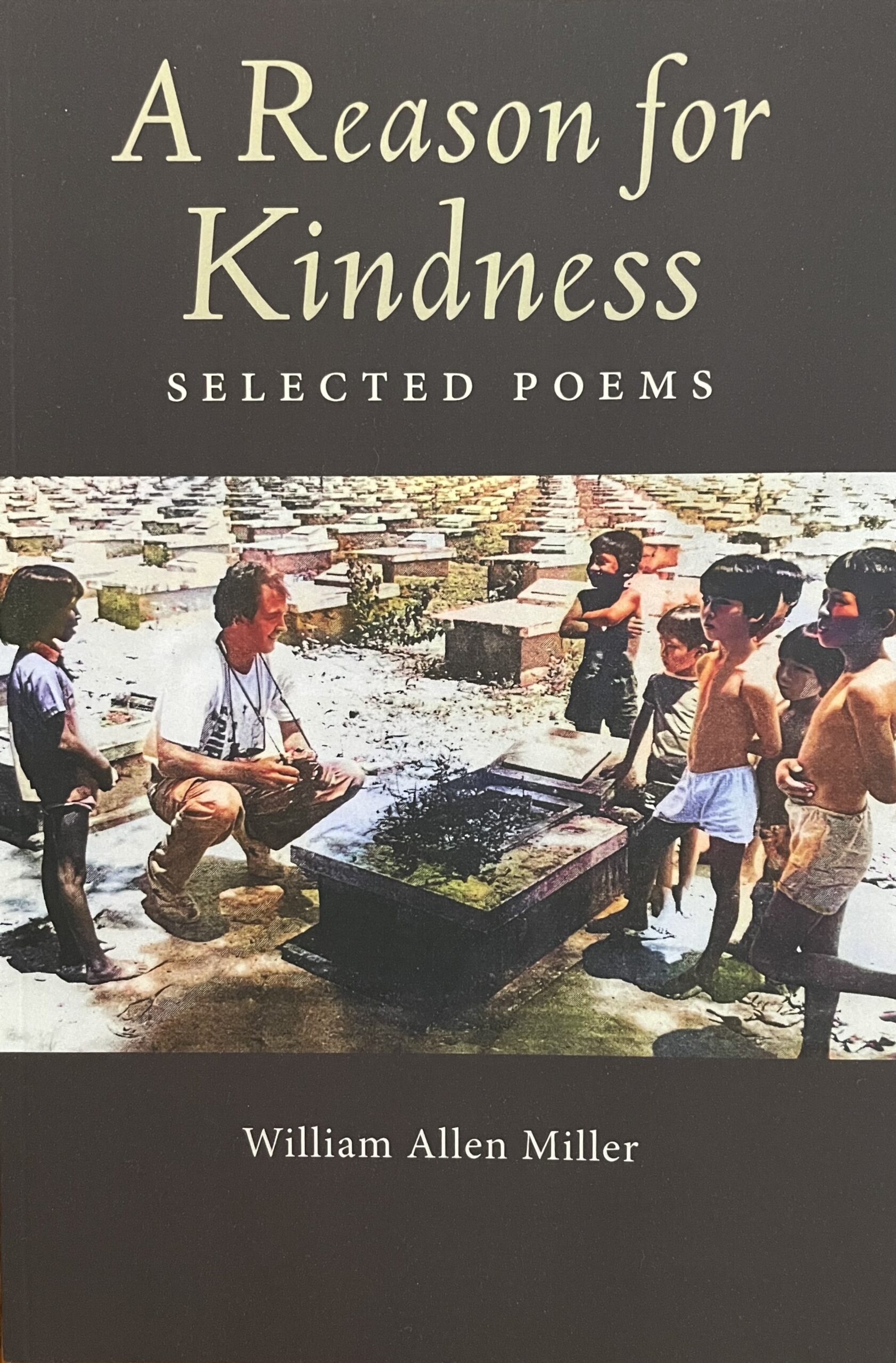
A Reason For Kindness by Al Miller “How a kid from an ordinary Midwest family could be turned into a weapon whose humanity could never be extricated and whose eventual self-forgiving peace will never be fully realized is the subject of Miller’s exquisitely rendered, deeply felt, intelligently explored narratives: among the very rare and most powerful works of anti-war world literature. Richard Anderson, author of We Called Him Bunny

Al Miller will read from his book: A Reason for Kindness Selected Poems on June 21st at 3:00 p.m. at the Montague Common Hall in Montague Center, Massachusetts.

Copies of the book can be ordered from Levellers Press, Florence MA https://www.levellerspress.com/?s=A+Reason+for+Kindness&v=a672068055fa and on Amazon

Prompt Photo

Posted in Uncategorized | Leave a comment

Spring Inward

Spring cleaning means getting rid of the winter soot and smears, letting the light arrive fully so everything looks more spacious, more sensible, more inviting. Spring cleaning in our writing can mean finding pieces that were abandoned because we didn’t trust that voice or didn’t believe in the metaphor, or the critics were looking too closely over our shoulder. As I was cleaning my house, I picked up a porcelain bowl that my mother had found at a thrift shop, I had always seen it as a pretty dish, nothing special, nothing particularly meaningful. As I stood on a chair, dust cloth in hand, I turned the small bowl over and saw the Royal Dresden mark on the bottom. My mother grew up in serious poverty and taught herself about fine art whether with fabrics, painting, music, or various kinds of three-dimensional beauty. I had dismissed this piece as nothing more than a whimsical tchotchke. I stood there hearing the litany of names my mother had learned: Limoges, Balique, Waterford, Wedgewood, Delft, Royal Dresden. This was a voice I heard during my childhood, and I heard it now again with appreciation. Rereading our work from years or months past is like turning over that bowl. We can hear that past voice with better clarity. Distance can remove biases or assumptions we have about our own writing, the characterizations we attach to our cadence, vocabulary, or metaphorical meanings. Go into your writing cabinets, turn over your pages, recognize the quality of phrasing and the wisdom of meaning. Let your past voice speak to you now and hear it with respect. Doing so can restore a sense of self we didn’t know was forgotten. That voice was reaching toward this present you, just as you are now writing toward your future self. Allow yourself that invaluable conversation.

Upcoming Events

Heat Wave Workshop! Need a reprieve from simmering temperatures? Join me for a two-day, in-person, open-genre, all-out spree of writing past the humidity and scorch. We will meet in Amherst, Massachusetts on July 11th & 12th and write in response to prompts that can only be delivered in person. We will follow the Amherst Writers & Artists workshop method of trust and respect; writers of all experience levels are welcome; space limited. Cost: $300. Information: maureen@maureenbjones.com

Prompt Photo

Posted in Uncategorized | Comments Off on Spring Inward

Of Rhyme and Random

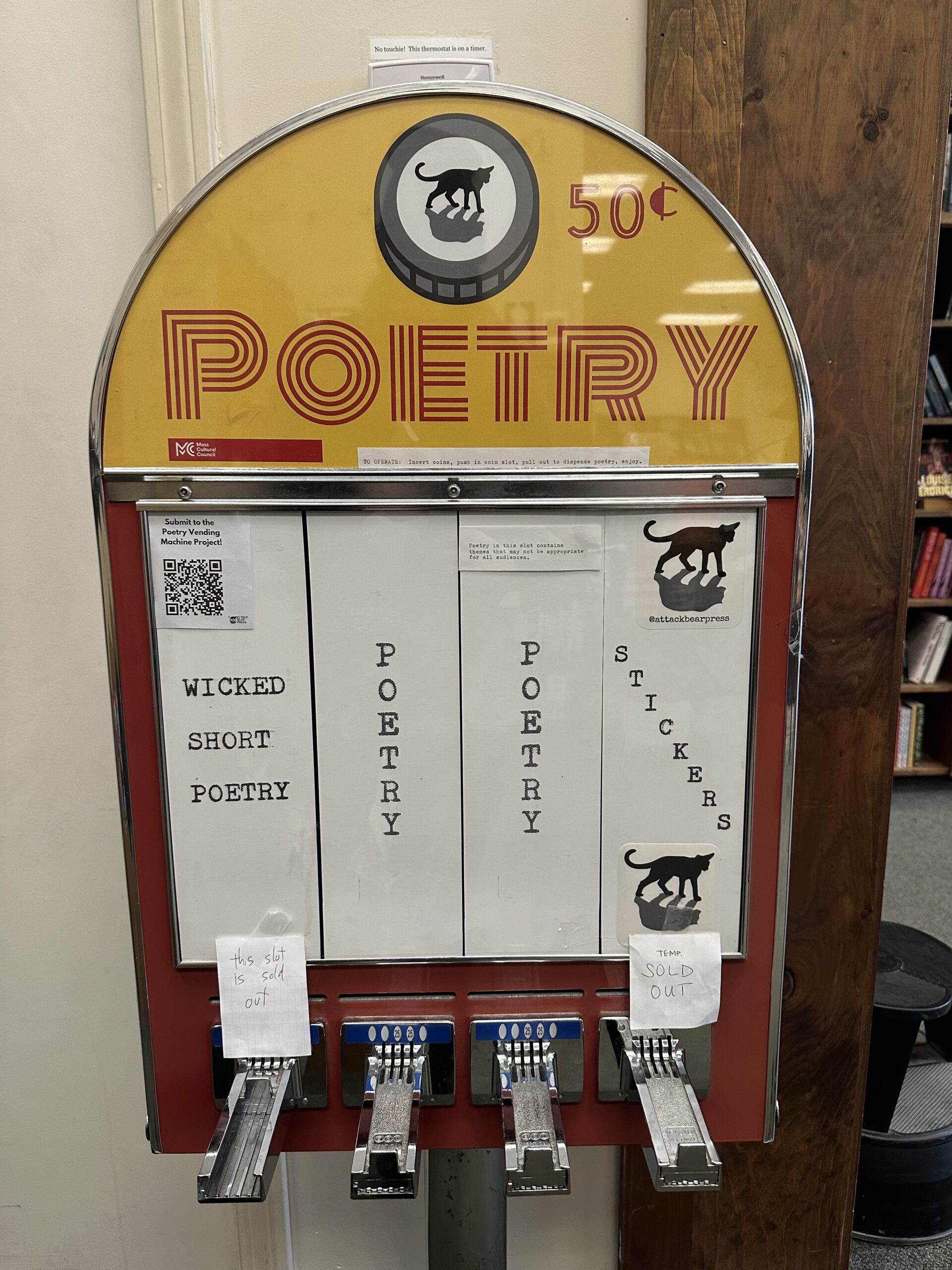
This week I ducked into Amherst Books, one of my favorite emporiums of words both new and used. As I perused the shelves, I came to the end of an aisle near the children’s section. There in the corner was what looked very much like an old postage stamp machine. It was. And it wasn’t. Someone with a poetic heart had turned the machine into a device that delivered a poem for fifty cents. Imagine! Two quarters for a poem! Even better, there were choices: a short poem, a general public poem and a poem for more mature audiences. When I placed the coins in their slots and slid them into the body of the mechanism, a cardboard folder emerged below the coin slot. Within the folder was a perfectly typed, original poem. Who could turn away from such a surprise? Who could not reach deep and scrounge desperately for the two magic discs that would procure rhythmic lines of metaphor? Actually, the poem machine reinforced what I have always loved about poetry, every poem is a surprise, whether it’s the unique use of language or syntax, the combination of imagery, the line breaks, the play of meaning, the comparison of an unlikely object to an experience, or the way heart and mind break open in a sudden surge of emotion.

Poetry is a surprising genre. No matter whether it is penned or delivered via a slot machine, it engenders unique self-expression and a form of communication beyond story telling. So, what are the poetic surprises you have encountered? What poem would you hope for if you stood before the machine? What poem would you write to surprise someone else? For the cost of loving words, your own poetry machine is waiting.

Upcoming Events

Heat Wave Workshop! Need a reprieve from simmering temperatures? Join me for a two-day, in-person, open-genre, all-out spree of writing past the humidity and scorch. We will meet in Amherst, Massachusetts on July 11th & 12th and write in response to prompts that can only be delivered in person. We will follow the Amherst Writers & Artists workshop method of trust and respect; writers of all experience levels are welcome; space limited. Cost: $300. Information: maureen@maureenbjones.com

Prompt Photo

Posted in Uncategorized | Comments Off on Of Rhyme and Random

Something This Way Comes

A week ago, six intrepid writers braved a nor’easter to come and write with me. As each one bent over a keyboard or notebook, it took little time for their bodies to relax and the writing mind to be transported into their writing. Not for the first time, I marveled at the capacity to enter the realm of creativity. So often I am asked by writers, “How does one begin? How do I find what I want to write?” In answer, I give the advice I was given many times: Take What Comes.

When I offer this wisdom, I frequently get a puzzled look in return, and that’s no surprise. Most of us are accustomed to being directed in our creative endeavors. We are given assignments, or very detailed directions on subject, genre, or craft. These entry points into writing access the intellect, which is the puzzle-solving part of the mind. It is also the part of us that wants to get a good grade and/or please the one delivering the writing task. This process fosters the inner critic, the one that says, “Don’t write that!” Or “That’s not the way to do it!”

What most of us creative types need, however, is not direction, but spark. And that spark exists infinitely inside of us. Recognizing and accepting the spark opens access to all the stories, poems, memoirs, and essays we already have within. The first step is to let the mind go where it wants to, not resist what shows up, no matter how unexpected, strange, or familiar. What comes is what wants to be written. And if it isn’t attended to, it will continue to haunt or impede, leaving a writer with a form of writer’s block. Giving voice to what arrives is allowing the conscious and the unconscious to converse. The first thing that arrives may or may not be where the writing continues to go, but it is the catalyst that begins the flow of images and ideas. This is where the original voice lives and where metaphor, character, and lyricism are born. This is where trust is built between the writer’s will and the writer’s freedom.

Promp Photo

Posted in Uncategorized | Comments Off on Something This Way Comes

Out of Necessity

Someone once asked me: “Why write this?” They were pointing to a copy of a poem I had offered for review by the workshop. I froze. The question was a wall I could not surmount. As I drove home, I began to tunnel under it. Why do any of us write anything? A foggy slice of moon smirked at me. I told the moon: I don’t know! I just wrote it. But that was dodging the point. Under the klieg-light examination of the workshop the poem had warped and gone limp. Perhaps my writing had no business being let loose in the world. And that’s what we do, isn’t it, when someone intimates that they know what should or should not be created. We shut down the mysterious internal foundry that transmutes thought, emotion, experience into art. We let the fire go out and tell ourselves: I’m not a writer. The problem is the fire doesn’t really go out. We are poets and storytellers from the first sounds we utter. How could we not know how to express our essential self? But it takes answering that challenging question, and it takes practice to find confidence. It takes experimenting with our own words and reading and listening to others’. It was years later that I came upon Ranier Marie Rilke’s Letters to a Young Poet in which he writes:

I cannot discuss your verses, for any attempt at criticism would be foreign to me. Nothing touches a work of art so little as words of criticism: they always result in more or less fortunate misunderstandings. Things aren’t all so tangible and sayable as people would usually have us believe, most experiences are unsayable, they happen in a space that no word has ever entered, and more unsayable than all other things are works of art, those mysterious existences, whose life endures beside our own small, transitory life. . . . A work of art is good if it has arisen out of necessity. That is the only way one can judge it.

Perhaps my fellow writer in that long ago workshop was trying to ask what Rilke so elegantly said. But like so many responses to created work, these ‘less fortunate misunderstandings’ are actually a learned formula of believing there is a narrow definition of worthy art. You may return to your tunnel from time to time. But it will reach daylight, and it is just as rich, varied, and articulate in its sheltered quiet as when it feels the wind in its voice.

Prompt Photo

Posted in Uncategorized | Comments Off on Out of Necessity

When Silence Speaks

The silence that comes with days of more dark than light offers more than hibernation. I’ve learned to look for still moments in my life and try to translate them into my writing. So often, in stories, these moments are called transitions as if they are simple corridors to the next big scene. But in the hands of a writer who works with pacing, they can function as out-of-time occurrences that help us understand subtle and complicated currents.

In The Two Towers, nearly at the center of The Lord of the Rings trilogy, a quiet, nearly still moment occurs between the bitter adversaries Gollum and Sam. Frodo, the main character, sleeps while they goad each other about the idea of helping. Each begins in their own way to find and prepare food. Their ideas conflict, but the actions are simple, and it’s maybe the only time that Sam can see Gollum as his former self, Smeagol. While they go about their tasks, the rest of Middle Earth is on the verge of collapse, and everything depends on them. Yet at the epicenter of this maelstrom, these two focus on nothing more than rabbits and potatoes. In a storyline of tremendous plot developments, Tolkien gives them this brief, uneventful interlude, because he knew his characters needed this respite. We readers need it too. And Tolkien needed it most of all. Of course, the fire that Sam builds for cooking leads to their discover, because the plot does have to move on. But a writer needs to recognize when it’s time to hold back and gather their story-telling forces so that they can send their characters forward into the most difficult choices. Sam, Gollum, and Frodo are facing the onslaught of Middle Earth’s darkest forces. They and we need to be grounded before they are plunged forward. In your writing life, see what these silences allow you to hear, see what the calm reveals. A driven poem or novel often asks for its opposite to prove its authentic pace. Lift the pressure for a moment, and see what shows itself in the smallest breathing space. The active world should suspend in a writer’s hands to give characters, readers, the writer the chance to find hidden truths. Cherish the motionless silence that names nothing but can mean everything.

Upcoming Events

Cabin Fever Workshop! Feeling confined? Need a winter boost? Join me for a two-day, in-person, open-genre, all-out spree of writing what’s bottled up, weighed down, air-deprived and waiting to be released. We will meet in Amherst, Massachusetts on February 21st & 22nd and write in response to prompts that can only be delivered in person. We will follow the Amherst Writers & Artists workshop method of trust and respect; writers of all experience levels are welcome; space limited. Cost: $300. Information: maureen@maureenbjones.com

Podcast Interview

Amherst Writers & Artists has launched its podcast The Creative Pen, with host Ginger Rex! Ginger invited me as the first guest to talk about the AWA Workshop Method and how it delivers a way for all writers to find their truest voice. Listen here: https://open.substack.com/pub/amherstwriters/p/the-creative-pen?r=2h8wen&utm_campaign=post&utm_medium=web&timestamp=37.3

Prompt Photo

Posted in Uncategorized | Comments Off on When Silence Speaks

Creative Knowing

In the words of the apparently immortal Mick Jagger: “You can’t always get what you want.” We can sing along to this hard-earned wisdom, and, like so many life lessons, we can accept it or not. Turning the idea around, I think of what my Tai Chi teacher, Wolfe Lowenthal, repeats: “Let go of the desperate will to succeed.” Both Mick and Wolfe are saying the same thing: Stop trying so hard and accept what is already given. Creativity asks for the same kind of acceptance and is infinite if we stop forcing it. Creativity is about listening to your inner voice. This is your deepest source of knowing. The mystery is that inspiration often arrives in a gift you don’t recognize, so you abandon it. For example, you begin by wanting to write about a chosen character, scene, moment, or experience, but the image of an unlaced shoe appears. You swat it out of the way and struggle on, but the writing is like overworked dough, tough and unwieldy. You try again, and the shoe, a scuffed leather work shoe with slightly mismatching laces and a worn-down heel sneaks up on you again. This shoe is your inner voice. It is your inspiration. The harder you try to ignore it, the harder it will be to write the poem or story you assigned yourself. Listen to that shoe by getting close up, pay attention to how the toe is scraped, how the grommets are tarnished, how the tongue strays to one side. Oh. The tongue. The tongue is saying something: A day of hard work, and a reprimand from the boss. A day with apple blossoms on the trees, and a song on the radio, and a fellow worker says, . . . . Now you are off and running, racing, writing as the scene opens before you and you are no longer pushing but breathless to keep up. Your words arrive and arrive, and your words unfold into what they want to be. Our creative gifts are inside us. All of them. We don’t need to search, or peek, or cheat, or guess. We need to accept what is given with the kind of generosity and gratitude we extend when someone gives us a present we didn’t ask for, didn’t necessarily want, or even like. No matter what is placed before us, the acceptance of this gift is easy: take it; it’s yours; it was chosen because it’s been waiting to share its treasure and surprise with you. Learn to trust that wild and strange voice that beckons you forward, and “You’ll get what you need.”

Upcoming Events

Cabin Fever Workshop! Feeling confined? Need a winter boost? Join me for a two-day, in-person, open-genre, all-out spree of writing what’s bottled up, weighed down, air-deprived and waiting to be released. We will meet in Amherst, Massachusetts on February 21st & 22nd and write in response to prompts that can only be delivered in person. We will follow the Amherst Writers & Artists workshop method of trust and respect; writers of all experience levels are welcome; space limited. Cost: $300. Information: maureen@maureenbjones.com

Podcast Interview

Amherst Writers & Artists has launched its podcast The Creative Pen, with host Ginger Rex! Ginger invited me as the first guest to talk about the AWA Workshop Method and how it delivers a way for all writers to find their truest voice. Listen here: https://www.dropbox.com/scl/fi/u4cofpnhz78ze17tareju/1-AWA-Podcast-Maureen-Buchanan-Jones.mp4?e=1&oref=e&r=AChkbO2frZ0OdfVB7sUzJMyXooqHdhA835mPIEeJz4zis_8D294chtOTNwSt6WUCdeVPV6L5-pvBNwP-FWJ3X-9f7TuNtgvx1boQTDjBlPbuI2vNlnN3-TFdzalU1I7_qNR8lhL_fwQCeZsEGTZE0RuxW2df1gLT14475kAciWsBVjVfFwI9seUpR2A1yH-yewevHQjLgbnHR9cLgGVkNWrY&dl=0

Prompt Photo

Posted in Uncategorized | Comments Off on Creative Knowing

The First Rule of Art

When writers ask me what form a piece of writing should take, I think of my distinguished journalism professor, Larry Pinkham, who spent eight years in Beijing establishing English-language journalism programs and two years in India as dean of the newly founded Asian College of Journalism in Chennai. He taught at the Columbia University Graduate School of Journalism and then at the University of Massachusetts where I met him. He certainly knew his way around putting words together, and storytelling was at the heart of his teaching.

Each time he gave a writing assignment at least one would student ask: How long should this news article be? Professor Pinkham never failed to give us the only answer I have ever heard that made sense to me. It is the answer to fit every writer’s question of what a novel, short story, essay, news article, or poem ‘should’ look like. With a small quirk at the corner of his mouth he would quote the French sculptor Rodin. “Rodin was once asked how large a sculpture should be,” Professor Pinkham would begin. “His answer,” and here our professor would pause to look at each of us. “His answer was: It should be of enough mass and weight so that when rolled down a hill, its arms don’t break off.”

I offer this wisdom from Rodin and Professor Pinkham. Find the weight and mass of your own words. Say what you want to say and experiment with how you want to say it. The length and structure will become evident as you allow the content to shape itself. There is no one way to create art. That’s what Professor Pinkham was teaching: make your own rules. Shape your work so that it best holds what you want to express and that shape will protect the art down whatever hill a reader decides to roll it.

Upcoming Events

Cabin Fever Workshop! Feeling confined? Need a winter boost? Join me for a two-day, in-person, open-genre, all-out spree of writing what’s bottled up, weighed down, air-deprived and waiting to be released. We will meet in Amherst, Massachusetts on February 21st & 22nd and write in response to prompts that can only be delivered in person. We will follow the Amherst Writers & Artists workshop method of trust and respect; writers of all experience levels are welcome; space limited. Cost: $300. Information: maureen@maureenbjones.com

Prompt Photo

Screenshot

Posted in Uncategorized | Comments Off on The First Rule of Art

Any Room of One’s Own

I have spent a lot of time in laundromats and find the sound and the warmth of those big machines very comforting. I have also discovered that my mind wanders wonderfully as shirts, sheets, socks swirled and spun. So I have a habit of bringing a notebook with me to write whatever is on my mind or arises from the slap and bump of clothing being tossed about. Certainly there is a lot of inspiration in the micro-climate of a laundromat, but it’s the realization that I can claim my creativity in more than a room at home that’s the real gift.

I have heard many writers worry that they have no time to write. I easily commiserate. Time gallops along, filled with endless tasks and responsibilities. Our attention is gripped by obligations and other’s needs. Virginia Woolf was not wrong to exhort each of us to claim a room of our own and carve out time to exist within it. But even with access to that room, life pushes us on us, and the struggle to get back to our creative cave takes energy. My answer is to steal time. The world does not care if you take fifteen extra minutes to go grocery shopping. Sit in the car before you go in and write. The world does not care if you write while waiting for a tune up on your car. It does not notice if you write while sitting at the airport during a layover. The world will not charge you extra if you take ten more minutes after going to the gym, the hair salon, the deli, the bookstore. And it will not report you if you write on the subway or in the back of a cab. The world most definitely will applaud you if you write while being put on hold. All of these moments contain plenty of stimulation, emotions, and inspiration. Write about them! Or write around them as escape.

Nearly every day we can find ourselves ‘waiting hostages.’ Liberate yourself and fill the time with your words. Talk to yourself and let your characters talk to you on a walk, on a run, on a bike ride. This is also writing. Allow your creativity to surface no matter where you are, it will feed the times when you are able to stretch fully onto your page. Your notes from ‘stolen’ writes will be prompts, beginnings of poems or scenes, or flash fiction. They will be reminders of what you want and need to say. For starters, take your wash to the laundromat and see what tumbles out.

Upcoming Events

Swamped, written and directed by Court Dorsey and a decades-long AWA workshop writer, walks the perilous lines among currently conflicting points of view. As an experienced and dedicated conflict negotiator, Dorsey has stood at the intersection of those lines.

“Swamped Is a culture clash of red and blue state values. It is a healing saga, a cautionary tale. All told, it’s a story of personal contact, which may be the only real road to reconciliation we have left.” Court Dorsey, Playwright & Director

Swamped runs Thursdays to Saturdays 10/16, 10/17, 10/18, 10/23, 10/24, and 10/25 at 7:30 pm, Sundays 10/19 and 10/26 at 2 pm. All performances at the Wendell Meetinghouse (1 Morse Village Rd., Wendell MA 01379). https://wendellmeetinghouse.ludus.com

Prompt Photo

Posted in Uncategorized | Comments Off on Any Room of One’s Own

The Why Behind the I

My neighbors to the east and west of me talk to me about chickens. Not the price of them or how many breeds there are. They talk about the sound of them and their eggs: “I love the soft sound of the chickens clucking!” and “I just know those chickens are attracting vermin!” These conversations are directed at the house across the street where eight chickens live. The across-the-street neighbor has offered eggs to the East and West neighbors. West is delighted to accept the eggs, because they remind West of growing up near a farm, watching the animals and hearing the chickens’ voices. East refuses the eggs, believing this will encourage keeping dirty chickens, and perhaps attracting rats. East grew up in the city, hating pigeon droppings on the windowsills and seeing rats in the garbage bins behind their building.

Each of these neighbors tells their story using the I point of view, but they also have depth beyond their POV. They have perspective, which is their world view, their lived experience and system of beliefs. West brings a world view that includes interacting with farm animals and welcoming the chance to benefit from them. East has a world view that fears wild animals as carriers of dangerous diseases and inviting unwanted pests.

West and East don’t see eye to eye about chickens and a good deal of other things. Neighbors can be like that. They, just like characters with differing perspectives add dimension and complexity to a story. Neighbors and characters give us a chance to understand that even when sharing proximity equal values are not shared. These differences can be a primary source of tension or simply added currents that help inform the main character and the plot. Perspective is what’s working behind the eyes of every character. It’s the why behind opinions that are often followed by actions. West accepts fresh eggs; East buys store bought. What your characters do is plot, why they do it is perspective. No matter what kind of eggs they choose, are the eggs hard boiled or over easy?  

Prompt Photo

Posted in Uncategorized | Comments Off on The Why Behind the I